The following is the opinion of the author.
In recent years, there have been many “explosive” opening structures (windows, blinds, devices to block the ventilation channels) which, when the blast wave of the structure allegedly “instantly automatically go into a closed position and protect people and equipment from the impact of the shock wave”.
Consider a similar situation and try to calculate the closing time of the conditional window leaf in the first case using primitive school formulas, in the second - a somewhat more complex method.
Suppose that there is a window flap height b, width a. mass m Fig. 1.
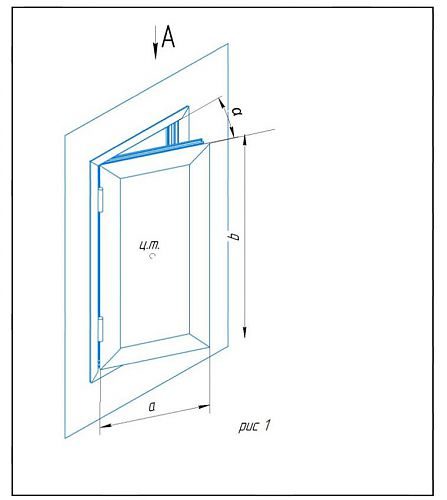
On which the shock wave begins to act with a maximum excess pressure in the front of 50 kPa, lasting 30 ms. UV propagates at the speed of sound in the air. Fig 2.
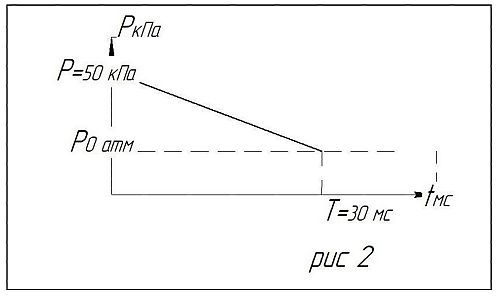
Suppose that UV comes from the most “favorable” for closing the direction – orthogonal facade.
The flap "hangs in the air", nothing prevents it from closing under the influence of the force F=P*S
The centre of mass of the leaf must pass the distance L under the action of this force.
Remembering school formulas L=a*t2/2=v*t/2
Hence t=(2*L/a)1/2=(2*L*m/F)1/2=(2*L*m/(P*S))1/2=(2*L*m/(P*a*b))1/2
Where:
m- leaf mass 42.6 kg
P = excess pressure of 50 kPa
a,b - width and height of the flap 0.7 m and 0.9 m
L (α=150, a = 0.7 m = 0.09 m
we get t (closing time) -(2*0.09*42.6/(50 000*0.9*0.7))1/2 =~15 ms
i.e. of 30 ms of shock wave 15 ms shock wave will flow into the room.
Let us now consider this case in more detail.
Assumptions: 1. UV is a flat, orthogonal facade with a window opening.
2. The facade part of the leaf (structure) is flat, symmetrical relative to the middle
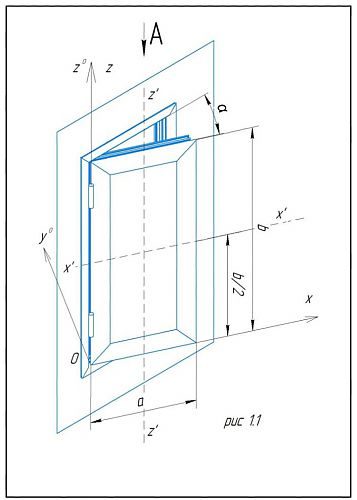 lines (vertical and horizontal) with a homogeneous mass distribution, mk is the total mass of the structure.
Fig 1. 1st
3. The external gas dynamic load is symmetrical with respect to the x'-x axis. It consists of the pressure in the reflected UV from the surface of the rotating leaf. At t=0, the UV front touches the front edge of the leaf with an angle of α0 (Fig. 3).
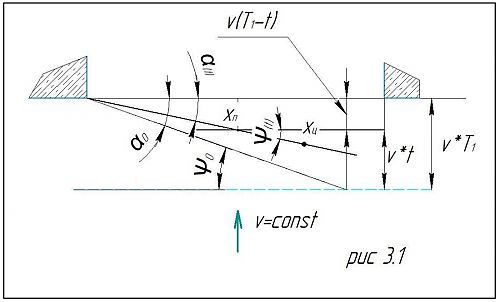
T1 =a*sin α0/V (2)
Xn=V*(T1-t)/sin αt (3)
Xn=Xn+ (a-xn)/2=(a+x)n)/2 (4)
At an arbitrary moment t, the flap area occupied by the reflected LV = b*(a-xn)
4. Effects associated with the "dripping" of gas from the edges of the flap to the area of low pressure behind the front of the departed UV, gas flowing into the rear part of the flap, pressure change on the front and rear parts of the flap due to the rotation of the flap below are not taken into account.
5. The closing time of the leaf under the action of flat HV is determined from the movement of the leaf α(t) at α(T)2) = 0. α(t) is determined from the solution of the equation of motion:
Jz'*d2α/dt2=Mz—Mtp (5)
Mz=FP(t)*Xz, Fp(t)=)sp(t)P2(x,t)dS (6)
P2(x,t) - the pressure in the reflected UV on the part (a-x)n)*b of the flap surface,
xz-centre of pressure,
Mpr- the moment of friction in the loop nodes (not taken into account below),
Axial moment of inertia Jz
Suppose, for simplicity of calculation, that the leaf is a uniform in density simple plate, height b, width a, mass of the structure mk.
Jz- moment of inertia of the flap relative to the rotation axis z(z)0).
Axial moment of inertia Jz= Jz'+m*a2/4 is Steiner's theorem.
Jz'moment of inertia with respect to the z' axis of symmetry of the structure
Jz'=mk*a2/12, Jz=Jz'+mk*(a/2)2=mk*a2/3
mk=ρp.*Vk
ρp.- present effective density, Vk - volume of contraction
C=d*[(2*j*P1m)2/((j-1)*P1m+(j+1)) – 1],
d=Pa*a2*b*T11/(2*α0*Jz)= (Pa*a2*b*a2*sin2α0/v2)/(2*α0*mk*a2/3)=[3*α0*ρa*a2*b]/[2*j*mk*((j+1)*p1m+(j-1)].
C=[3*ρa/(2*j)] * [α0*a2*b/mk]*{(2*j*P1m)2-[(j-1)*P1m+(j+1)]}/{[(j+1)*P1m+(j-1)]*[(j-1)*P1m+(j+1)]}.
d2α’/dt’2=-C*(1-(1-t’)2/α’2) at (α'>0, t'<1); t'=0, α'=1, α'=0 or -C at α>=0, t'>=1/
Some characteristics of falling and reflected flat UV.
Basics of gas dynamics. Chapter V. IL. 1963.
2. Stanyukovich K.P. Unsettled movement of continuous environment. Fismatlite. 1971.
Assumption: 1. Reflection of oblique flat UV from all points of the surface of the leaf is assumed to be regular. Contribution to the dynamics of the flap at the moment of touching the UV front with the flap edge, where the fly reflection from the right angle of the edge is realized is considered insignificant.
2. The angle of fall of the UV front is considered small. )=α(t)<<1 (Figure 3).
[2] chap. 29 29
"0" is the region of resting gas V0=0, P0=Pa, ρ0=ρa
"1" - area behind UV V front1, P1, ρ1
Φ — angle of incidence of gas flow UV I with the front reflected UV II
Rice. 5. (A picture of the current in a movable coordinate system in which xn stationary.
[1] (2.8, 2.9’) M0=Ϭ’=(V-v0)/a0=[{(j+1)*ζ’+(j-1)}/(2*j)]1/2 (8) ζ’=P(t0)=P1(t0), P0= Patm
Here's t.0=0 ζ’=1,5/1 j=1,4 M0~=1.2 v=406 m/sec
(*) ρ1/ρ0={(j+1)*ζ/(j-1)}/{ζ'+(j+1)/(j-1)} here ζ'=1.5 ρ1/ρ0=1,3 (3)
[2] tgθ={tgΨ*(ρ1/ρ0-1)}*{ρ1/ρ0+tg2Ψ} β={2*[1+(ρ1/ρ0)2*ctg2Ψ]}/{(j+1)*ρ1/ρa-(j-1)} -> Ψ=α(t),θ(t),β(t)
(32.27, 32.28, 32.29) -> tg3F*tgθ*{(j-1)*β/2+1} -tg2F*(β-1)+tgF*tgθ*{(j+1)/2+1)+1=0
(32.30) {P2/P1=[2*j/(j+1)]*β*sin2F-(j-1)/(j+1) -> P2(t)/P1, P2/Pa=(P2*P1m)/(P1*Pa) P1m/Pa=const}
P2/Pa(t) -> (6) -> Fp(t), Mz(t)
For small angles Ψ=α<<<1 tgθ~θ; tgΨ~Ψ; tgF~F
θ~=Ψ*[ρ1/ρa-1]/[ ρ1/ρa+Ψ2 β~={2/Ψ2}*{[Ψ2+( ρ1/ρa)2]/[(j+1)* ρ1/ρa-(j-1)]}
If α0=150, Ψ=150=0,262 (tg150=0,268) Ψ2<= 0,069 (tg2150=0,072) θ/Ψ~=0,251 θ<=0,25*0,262=0,066
Now (32.30) neglecting tg3F and denoting ρ1/ρa= ρ1’
F/ =[(j+1)*ρ1'-(j-1)]/(2* ρ1') -> F~ // F/ =[2,4*1,3*(3)-0,4]/[2*1,3*(3)]
β*sin2F~β FF2=1/2*[(j+1) ρ1’-(j-1)]
P2/P1~=j*[P1'-(j-1)/(j+1) (9) In the region of small angles Ψ=α, the pressure in the reflected shock wave does not depend on the angle of rotation of the leaf => does not depend on time! And taking into account the assumption 4 is the same at all points on the surface of the leaf in the section (a-xn) and, therefore, the center of pressure is in the middle of the section a-xn:xn=(a+xn)/2
For P.1m’=P1m/Pa=1,5, ρ1’=1,3 (3), P2/P1~=1,63, P2/Pa~=2,45
Dynamics of the flap
(6)-> Fp=∫s(t)(P2-P1)dS=(P2-P1)S(T)=[(2*j*P’1m)2/{(j-1)*P1m’+(j+1)}-1]*Pa*b*(a-xn)
Mz=-Fp*xw=-(Pa/2)*[(2*j*P1m’)2/{(j-1)*P1m’+(j+1)}-1]*b*(a2-xn2)=
=-(Pa*a2*b/2)*[(2*j*P1m’)2/{(j-1)*P1m’+(j+1)}-1]*[1-(1-t’)2/α’2]
// xn2/a2=v2*(T1-t)2/{a2*sin2α}=[v2*T12(a2*sin2α0)]*[1-t/T1]2*[sin2α0/sin2α]=! v2*T11/(a2*sin2α0) = 1 Figure 3! = (1-t')2/α’2// t’=t/T1 α’=α/α0
(5)-> d2α’/dt'2=-(Pa*a2*b/2) *[(2*j*P’1m)2/{(j+1)*P’1m+(j+1)}-1]*[1-(1-t’)2/α’2] at α'>0, t'<1
-(Pa*a2*b/2) *[(2*j*P’1m)2/{(j+1)*P’1m+(j+1)}-1] at α'>=0, t'>=1
// (Pa*a2*b*T12)/(2*α0*Jz)={ (Pa*a2*b)*(a*sinα0/v)2}/{2*α0*Jz}=
Page 51! = α0*(a*ρa/jsc)*1/[(j+1)*P’1m+(j-1)]
(11) d2α’/dt’2=-C*[1-(1-t’)2/α’2 at α>0, t'<1 -C at α>=1, t>=1
C= {α0*a*ρa/[ jsc*[ (j+1)*P’1m+(j-1)]}*{(2*j*P’1m)2/[(j-1)*P’1m+(j+1)]-1}
11.1 – by the time the falling UV facade is reached, the flap has not yet closed
11.2 UV reached the facade and was reflected, on the entire surface of the leaf there is a constant pressure in the reflected UV. The shutter continues to close earlier (t>) = T1)
P.S. Assuming the shutter closes before t< T1 It is unlikely because it would mean that the speed of the leaf is greater than v. Then there would be backpressure on the back side of the flap to form UV and the flap would close more slowly than in case 11. 1st
As a result, the Cauchy problem (with initial conditions) for the DC type
y2*y’’=-C*y2+(1-x)2 x=0: y=y0=1, y’=0 // y>0, x<1
α'=ω* angular velocity of the leaf
dω*’/dt’=-C*[1-(1-t’)2/α’2t'=0, α=1, ω=0 // α'>0, t'<=1 considering that dα'/dt'=ω' à ω'(1) α'(1)
t’>=1:
dω’/dt=-C, ω’(t)=-C*(t’-1) +ω’(1)
dα’/dt=ω’=-C*(t’-1) +ω’(1), α(t)=-C*(t’-1)2/2+ ω’(1)*(t’-1)+ α(1)
α(T’2)=0=-C*(T’2-1)2+ω’(1)*(T’2-1)+α(1)
T’2=T2/T1=1+ω’(1)*[1+(1+2*α(1)*C/ω’2)1/2]/C
Example of calculation
α0=150= 0.261 rad, a=0.7 m, j=1.4, P'1m=1,5, a0=340 m/s.
rice 3. T1=a*α0/v (α0<0), T1=-0,7*(-0,261)/408,4=4,5*10-4 sec
v=a0*[{(j+1)*P'1m+(j-1)}/2*j]1/2=340*(4/2,8)1/2= 408 m/s
Jz*d2α/dt2=Mz; Mz=Fp*xn; Fp=Pa*(P2/Pa-1)*b*(a-xn) at t<=T1, Fp=Pa*(P2/Pa-1)*b*a at t>1
xn=-v*(T1-t)/α; xn=(a+xn)/2
Mz=[b*a2*Pa]/2 * (P2/Pa-1) * (1-xn2/a2) at t<=T1, Mz=b*a2/2 *Pa*(P2/P1-1)
(xn/a)2=v2*(T1-t)2/α2=(α0/α)2*(1-t/T1)2
Jz=mk*a2/3.
d2α/dt2=Mz/Jz=b*a2*Pa*3 (P2/Pa-1)*(1-xn2/a2)/(2*mk*a2) at t<=T1,
or 3*b*Pa(P2/Pa-1)/(2*mk) =C for t>1
t<=T1: α'(t)=C*[1-(α0/α)2]*t+C*(α0/α)2*(t2/T1-t3/3T12)+ const
α'(0)=0, const=0
(1) α'(t)=C*[1-(α0/α)2]*t+C*(α0/α)2*(t2/T1-t3/3T1)
dα/dt=α'(t)
α(t)=C/2 * [1-(α0/α)2]*t2+C*(α0/α)2*[t3/3T1-t4/12T12]+const
α(0)=const
α(t)=α(0)+C/2 *[1-(α0/α)2]*t2+C*(α0/α)2+C*(α0/α)2*[t3/3T1-t4/2T1]
α(T1)=α(0)+C*T12*[1/2-1/2 *(α0/α)2+C*T12*(α0/α)2*[1/3-1/12]=α(0)+C*T12/2 *[1-1/2 *(α0/α)2]
t>=T1 --->
α'(t)=C*t+const, α'(T1)=C*T1+const const=α'(T1)-C*T1
α'(t)=C*t-C*T1+C*T1*[1-1/3 (α0/α)2]=C*t-C*T1*(α0/α)2
dα/dt=α'(t)
α(T1)=α(0)+C*T12*[1-(α0/α)2/2]/2
α(t)=α(0)+C*T12*(α0/α)2/12-C*T1*(α0/α)*t/3+C*t2/2
α(T2)=0=α(0)+C*T12*(α0/α)2/12-C*T1*(α0/α)2*T2/3+C*T2/2
T2'=1/3 (α0/α)2 + - {(α0/α)4/9 -2*α0/(C*T12)-(α0/α)2/6}1/2
And so we continue to see transformation.
T2=T1*[-2*α0/(C*T12)]1/2=37*10-3 sec
α'(T2)=~C*T2= 14 1/sec
V(T2)=a*α'(T2) = 9.9 m/s
I will try to summarize all the above in simple words.
Passing UV reaches the facade and, with regular reflection, forms a reflected UV, which immediately begins to flow into the opening, into the protected room forming a cylindrical shock wave that propagates at a small angle along the wall (almost parallel to the plane of the leaf) already inside the room, gradually turning to the center of the room.
After 37 ms (i.e. VUV all the time of its action penetrated into the room), the flap at a speed of about 35 km.h crashes into the frame.
Indirectly, the above is confirmed by the experiment of 04.12.2020 conducted by JSC "Alfa"
When detonating a test charge of 500 kg of TNT at a distance of 53 meters, a test bench with 20 feet ajar open0 the hatch, was exposed to a passing shock wave with the Foreign Ministry in the front - 25.7 kPA, while the sensor inside the stand at a distance of 1 m from the plane of the facade located in the center of the hatch, recorded a pressure jump to -6.1 kPa. Rice 4

Therefore, opening blast protection structures must be closed and locked at the time of explosion, despite the fact that the VC is weakened and changes direction.
Or should be equipped with self-closing devices, triggered by a signal from an overpressure sensor located directly at the site of the explosion or in advance of an alarm signal, for example, given by a gas analyzer. However, neither in the first nor in the second case does not give a 100% guarantee of protection of personnel and property.
Our company has developed both types of devices.
We will help you choose and calculate the protection – the consultation is free.