The following is the opinion of the author.
For example, it is necessary to choose an blast protection door for an operator or other protected building at an explosion-hazardous object of an oil and gas or petrochemical complex.
A design engineer, or other authorized person, usually collects certificates from manufacturers and reads them carefully, comparing product testing parameters with the explosive load to which a protected building is exposed in an emergency.
Suppose there is a barrier (window). Door, hatch), tested by detonation of 500 kg of TNT in 30 meters, class VZ 50 according to GOST R 57471-2017 outm 1.
And the door, tested in class 4 GOST 57471-2017 (lost force). VU 4 corresponds to 200 grams (0.2 kg) of TNT at a distance of 1 meter.
The air shock wave has four main characteristics:
The maximum excess pressure (hereinafter referred to as the Ministry of Foreign Affairs) is the same amplitude, usually measured in kPa;
Duration of positive phase in milliseconds;
Form;
Front speed.
What parameters should pay attention, when choosing an explosion-proof (say) door, to an explosion-prone object.
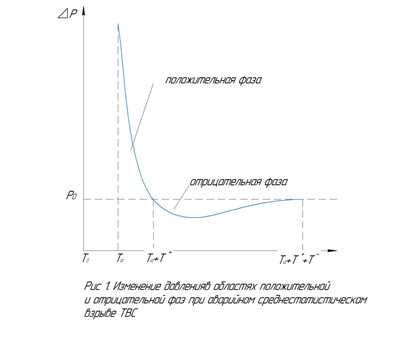
In Appendix No. 3 to the Safety Manual “Method for assessing the consequences of emergency explosions of fuel-air mixtures” dated March 31, 2016, the characteristic profile of the shock wave during the explosion of the TVS displays as follows: RIS 1.
The same epiure is built for the effect of 200 grams (0.2 kg) of TNT in a meter from the barrier RIS 2:

And for exposure to 500 kg TNT, at a distance of 30 meters, RIS 3:
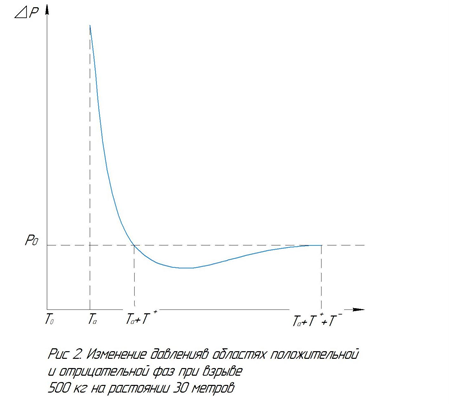
It looks pretty, doesn't it? Now let’s reduce all three epiures to one graph: RIS 4
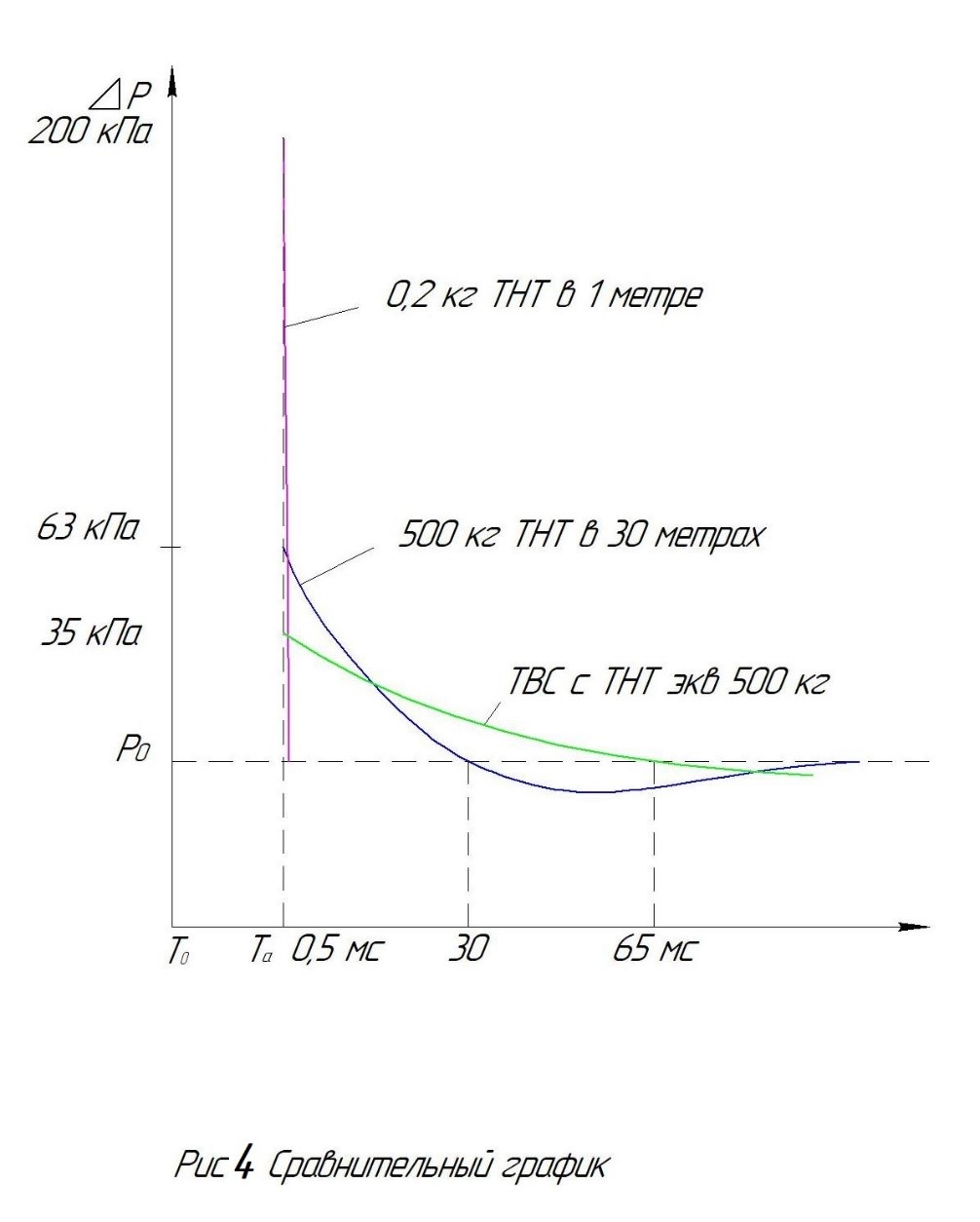
As can be seen, despite the impressive amplitude of 200 kPa, the duration of exposure to 200 g TNT, 60 times less than 500 kg, and more than 100 times less than the explosion of TNT equivalent of 500 kg.
Most designers usually do not take into account the duration of the compression phase, which is quite dangerous for filling the protected object and the people inside, omission.
Exposure to 200 grams will withstand any metal door
Now slides:
Testing the door of our production. Exposure to 8 kg of TNT at a distance of 1.7 meters. Maximum excess pressure in the front - 1320 kPa, Fig. 5,

The maximum deflection of the canvas is 6 mm Fig. 6
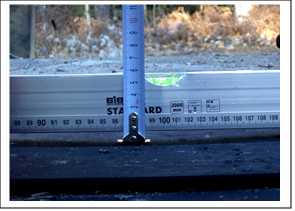
Now the same, but smaller door under the influence of 50 kg TNT at a distance of 6.1 meters Fig. 7.

The masquimal excess pressure in the front is 590 kPa, and the maximum deflection of the canvas is 21 mm. 8.

That is, with a greater amplitude of UV, greater excess pressure, the deflection of the same product is less. The reason is the duration of exposure to SV, its duration. With a charge of 50 kg at 6 meters, it is four times longer than that of 8 kg at 1.6 meters.
Deformations propagate at a constant and limited speed – the speed of sound in the material. During the first experience, the canvas simply did not have enough time to bend more. The load is sufficient, and the material is ready to deform further, but the load is already over. So when exposed to small charges, with a high, albeit megapascal load, the product often remains intact, remaining in the stage of elastic deformations, because plastic - to deflection, rupture, crack, simply does not have time.
P.S. When exposed to 500 kg at a distance of 30 meters, the same door was blown away along with the test stand.
We will help you choose and calculate the protection – the consultation is free.